
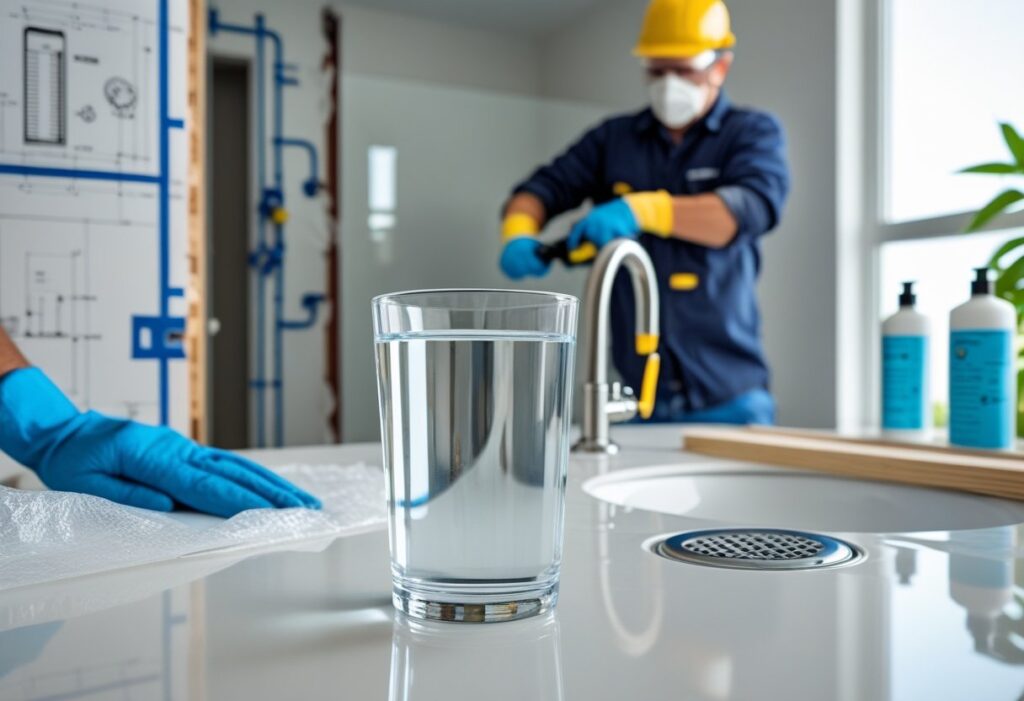
Why Queens Families Often Need Better Answers After Renovation and Plumbing Changes is a practical question, not just a search phrase. In Queens, a household water concern often begins with something ordinary: a child filling a cup, a sink that stains, a renovated kitchen that tastes different, a cloudy glass, or a neighbor reporting a similar problem. The difficult part is that everyday observations do not automatically identify the cause. Renovation work and plumbing changes can quietly reshape what reaches the tap. In Queens homes, that may mean new fixtures are interacting with older plumbing in ways that deserve closer attention. Water testing helps show whether those changes affected household water conditions in a meaningful way. This article would focus on why Queens families often need better answers after renovation and plumbing work. A thoughtful testing plan gives the concern a shape. It helps separate what can be seen from what must be measured, and it gives families, owners, boards, or buyers a better way to decide what deserves follow up.
Queens plumbing decisions: reading the concern before the numbers for Why Queens Families Often Need Better Answers After Renovation and Plu
Renovation can make water questions feel confusing because the visible surface looks new while older infrastructure may remain in place. A new faucet can be connected to an older branch line. A kitchen upgrade may disturb sediment. A contractor may replace one section of pipe while leaving mixed materials elsewhere. Testing after plumbing work can help show whether the change affected the water at the point of use.
Queens housing is unusually varied, with single-family homes, attached houses, garden apartments, co-ops, and renovated multifamily properties often sitting close together. This variety makes water questions highly property-specific. That is why a laboratory result should not be treated as a loose number floating outside the property. It should be read alongside where the sample was collected, how long the water sat, whether nearby work happened recently, and whether other fixtures show the same pattern.
How property type changes the sample plan for Why Queens Families Often Need Better Answers After Renovation and Plu
First-draw and flushed samples for Why Queens Families Often Need Better Answers After Renova
A useful sample plan starts by naming the decision the family needs to make. Is the goal to understand a stain, check a child-exposure concern, evaluate a recent renovation, compare two fixtures, or create a baseline before repairs? In Queens, those questions change which tap is sampled, whether a first-draw or flushed sample is appropriate, and whether the household needs a narrow screen or a broader panel.
For families who want a more organized path, what household water tests can measure can help match the test menu to the household question. A result becomes more useful when it is connected to practical water quality articles, because the homeowner can see whether the concern involves metals, bacteria indicators, potability markers, PFAS, or general chemistry. Local context also matters, so households can review contact a water testing specialist instead of assuming every property in the region should be tested the same way.
Lab markers that can confirm or complicate Why Queens Families Often Need Better Answers After Renovation and Plu
The main value of testing is that it translates a household description into measurable categories. Brown water may suggest iron, sediment, corrosion, or disturbed deposits. A metallic taste can point attention toward copper, iron, manganese, zinc, or other plumbing-related metals. A child-exposure concern may put lead, copper, and bacteria near the top of the list. A broad potability concern may include microbiological indicators, pH, total dissolved solids, nitrates, hardness, metals, and sometimes PFAS. CDC drinking water safety overview is useful for families because it connects drinking water concerns to daily household exposure, including children and pregnant people. EPA drinking water regulations provides the larger regulatory context for many drinking-water contaminants, including metals and microbiological indicators.
A plumbing decision should not be made from a single vague symptom. Replacing a faucet is different from replacing a branch line. Cleaning an aerator is different from reviewing a water heater. Installing treatment is different from correcting a cross-connection or bacteria issue. Water testing helps the family match the scale of action to the scale of evidence.
Turning the Why Queens Families Often Need Better Answers After Renovation and Plu report into a calm next step
Documentation that helps families revisit Why Queens Families Often Need Better Answers After Renova
The most useful interpretation connects results to plumbing behavior. Lead and copper may suggest corrosion-related conditions. Iron and manganese may help explain color or staining. pH and alkalinity can help explain whether water conditions may interact with plumbing materials. Bacteria indicators raise a different set of questions about sampling technique, plumbing integrity, treatment, and immediate use. In Queens, the lab report is strongest when it is paired with the home’s fixture map and water-use routine.
Homeowners should connect the report to maintenance priorities. If results suggest one fixture is the source, replacement or cleaning may be enough. If multiple locations show related findings, a branch line, water heater, treatment system, or service-entry condition may deserve review. Families can also use lab-based water analysis as a starting point, then move to contact a water testing specialist when they want help matching the concern to a practical testing plan. EPA guidance on lead in drinking water explains that lead can enter drinking water when plumbing materials corrode, especially in homes or buildings with lead-containing service lines, pipes, solder, faucets, or fixtures.
When results raise concern, families should avoid quick online fixes that ignore the contaminant. Boiling water can help with some microbiological advisories, but it does not remove lead or PFAS and can concentrate some dissolved substances. A pitcher filter may improve taste but may not solve a building-wide issue. The safest response is to connect the result to the correct contaminant, the correct fixture, and the correct professional follow-up.
When results look reassuring, the report still has value. It can become a baseline before renovation, a record for a board discussion, a reference after a newborn arrives, or a comparison point if discoloration returns. Water quality can change after construction, plumbing work, fixture replacement, water heater service, or long stagnation, so a clean result should be stored rather than forgotten.
Families should be especially cautious about explanations that sound confident but ignore the property. “It is just old pipes” may be partly true and still not specific enough. “The city water is fine” may describe the public supply but not the final water after building plumbing. “A filter will fix it” may be true for one contaminant and false for another. A test helps replace those shortcuts with details the household can actually use.
The final goal is not to create perfect certainty. The goal is to reduce unnecessary guessing. A well-planned test can show what was measured, where it was measured, and whether the finding fits the family’s concern. That clarity makes it easier to decide whether to monitor, retest, clean a fixture, discuss building plumbing, contact a professional, or take a more protective short-term step while the issue is being reviewed.
Across Queens, better water decisions begin with better information. A well-planned test can make repairs, maintenance, and long-term household choices more grounded. Water testing is not meant to create panic or replace guidance from a licensed plumber, public water supplier, local health department, or medical professional. Its value is that it gives households a more specific starting point when a concern is no longer just a guess.