
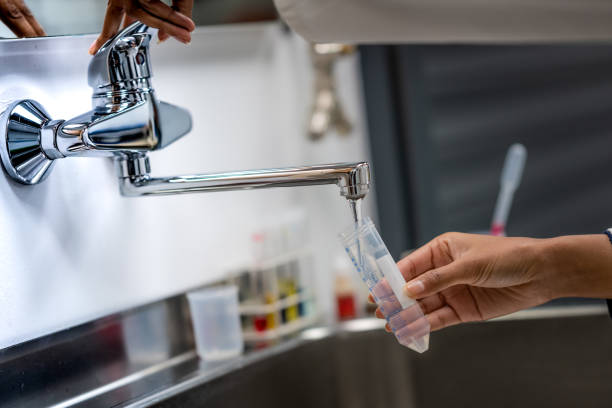
How Water Testing Helps Families Move Beyond Visual Guesswork is a practical question, not just a search phrase. In NYC and North NJ, a household water concern often begins with something ordinary: a child filling a cup, a sink that stains, a renovated kitchen that tastes different, a cloudy glass, or a neighbor reporting a similar problem. The difficult part is that everyday observations do not automatically identify the cause. A clear glass does not prove the water is fine, and a strange-looking one does not fully explain itself. Families deserve stronger answers about lead, bacteria, PFAS, common metals, and plumbing-related conditions than appearance alone can provide. Water testing replaces visual guesswork with more dependable information. This article would explain how testing helps families move beyond appearance-based assumptions. A thoughtful testing plan gives the concern a shape. It helps separate what can be seen from what must be measured, and it gives families, owners, boards, or buyers a better way to decide what deserves follow up.
Why the right test depends on the decision behind How Water Testing Helps Families Move Beyond Visual Guesswork
The strongest water questions are usually specific. Instead of asking whether the water is “good” or “bad,” a household can ask whether the sample shows evidence of metals, bacteria indicators, corrosion behavior, sediment-related concerns, PFAS, or general chemistry conditions. That shift helps the family avoid dramatic conclusions and focus on what the property is actually showing.
Across NYC and North NJ, water questions are shaped by dense housing, old and new plumbing mixed together, building management responsibilities, and a wide range of household routines. That is why a laboratory result should not be treated as a loose number floating outside the property. It should be read alongside where the sample was collected, how long the water sat, whether nearby work happened recently, and whether other fixtures show the same pattern.
Local plumbing variables that change interpretation for How Water Testing Helps Families Move Beyond Visual Guesswork
Comparing complaint taps and control taps for How Water Testing Helps Families Move Beyond Visual Guessw
When water looks normal, the sample plan must be driven by risk questions rather than appearance. Families may select tests because the home is older, a child or pregnant person uses the tap, the unit has new fixtures connected to older lines, or nearby households report similar concerns. In NYC and North NJ, a clear glass may still be worth testing when the property has mixed plumbing history or when the family wants a baseline before making filtration, plumbing, or maintenance decisions.
For families who want a more organized path, what household water tests can measure can help match the test menu to the household question. A result becomes more useful when it is connected to water testing laboratory support, because the homeowner can see whether the concern involves metals, bacteria indicators, potability markers, PFAS, or general chemistry. Local context also matters, so households can review plain-English water testing FAQ instead of assuming every property in the region should be tested the same way.
Contaminant groups not to confuse in How Water Testing Helps Families Move Beyond Visual Guesswork
The main value of testing is that it translates a household description into measurable categories. Brown water may suggest iron, sediment, corrosion, or disturbed deposits. A metallic taste can point attention toward copper, iron, manganese, zinc, or other plumbing-related metals. A child-exposure concern may put lead, copper, and bacteria near the top of the list. A broad potability concern may include microbiological indicators, pH, total dissolved solids, nitrates, hardness, metals, and sometimes PFAS. EPA drinking water regulations provides the larger regulatory context for many drinking-water contaminants, including metals and microbiological indicators. CDC drinking water safety overview is useful for families because it connects drinking water concerns to daily household exposure, including children and pregnant people.
Families often feel pressure to choose between ignoring the concern and assuming the worst. Testing creates a middle path. It does not promise that one bottle answers every question forever, but it can show whether a concern appears in the sample collected, whether the pattern matches the household observation, and whether follow-up should be narrow or broader.
From results to repairs, filters, records, or reassurance for How Water Testing Helps Families Move Beyond Visual Guesswork
Questions before changing pipes or filters for How Water Testing Helps Families Move Beyond Visual Guessw
Normal-looking water can still produce meaningful results. Some contaminants have no reliable color, smell, or taste at levels families care about. Lead is a prime example because it is usually not visible. Bacteria indicators are also not something a family can see in a glass. PFAS concerns are similarly invisible. In NYC and North NJ, testing gives families a way to examine what appearance cannot answer and to avoid both false reassurance and unnecessary alarm.
When a family is testing water that looks fine, the strongest next step is to define what would change based on the result. Would the family install a certified filter, ask a landlord for documentation, schedule plumbing review, test another fixture, or create a baseline before a baby arrives? Clarity before sampling makes the report easier to use. Families can also use residential water testing services as a starting point, then move to plain-English water testing FAQ when they want help matching the concern to a practical testing plan. EPA information on PFAS in drinking water notes that PFAS are regulated drinking-water contaminants, which is why some families include them in broader screening rather than relying only on appearance.
After results arrive, compare them with the original reason for testing. If the concern was staining, look at metals and chemistry that can plausibly explain staining. If the concern was children’s use, lead, copper, bacteria indicators, and relevant contaminants may matter more. If the concern was a purchase, the result should be read beside inspection notes and service-line observations. This prevents the report from becoming a confusing list of numbers.
When results raise concern, families should avoid quick online fixes that ignore the contaminant. Boiling water can help with some microbiological advisories, but it does not remove lead or PFAS and can concentrate some dissolved substances. A pitcher filter may improve taste but may not solve a building-wide issue. The safest response is to connect the result to the correct contaminant, the correct fixture, and the correct professional follow-up.
When results look reassuring, the report still has value. It can become a baseline before renovation, a record for a board discussion, a reference after a newborn arrives, or a comparison point if discoloration returns. Water quality can change after construction, plumbing work, fixture replacement, water heater service, or long stagnation, so a clean result should be stored rather than forgotten.
For families in NYC and North NJ, the clearest glass still cannot answer every question. Testing brings invisible concerns into view without forcing the family to rely on suspicion alone. Water testing is not meant to create panic or replace guidance from a licensed plumber, public water supplier, local health department, or medical professional. Its value is that it gives households a more specific starting point when a concern is no longer just a guess.